MotoGP Bike Specifications: Engine, Power & Tech Guide
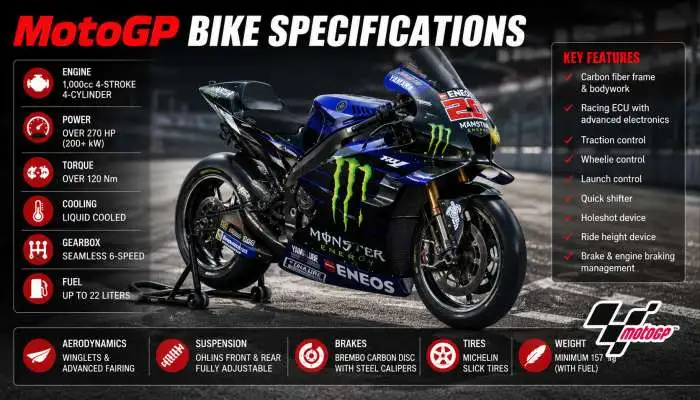
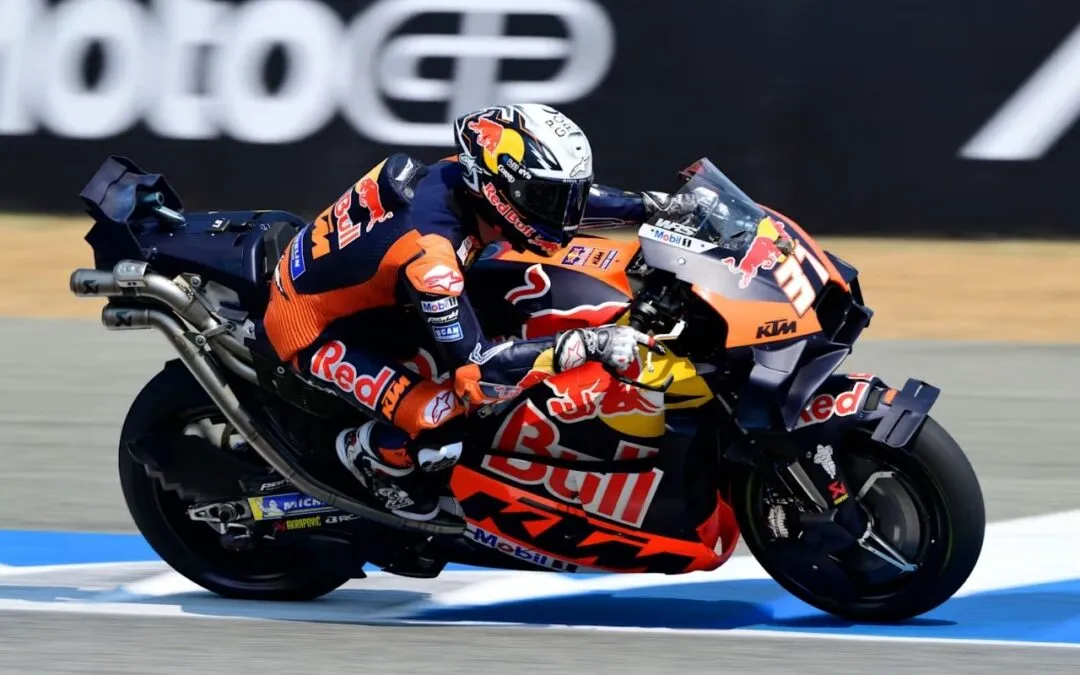

Have you ever watched MotoGP bikes scream down a straight line? They look like alien spaceships on two wheels. But what really makes them tick? The truth is simple: MotoGP bike specifications are the most advanced in motorsport. These are not your street motorcycles. They are pure racing machines built for one job: winning.
In this guide, I’ll walk you through every number and detail. You will learn about MotoGP 1000cc engine specs, weight limits, and real horsepower numbers. No engineering degree needed. Just simple, fun facts.
Current MotoGP Bike Specifications: The 1000cc Era Explained
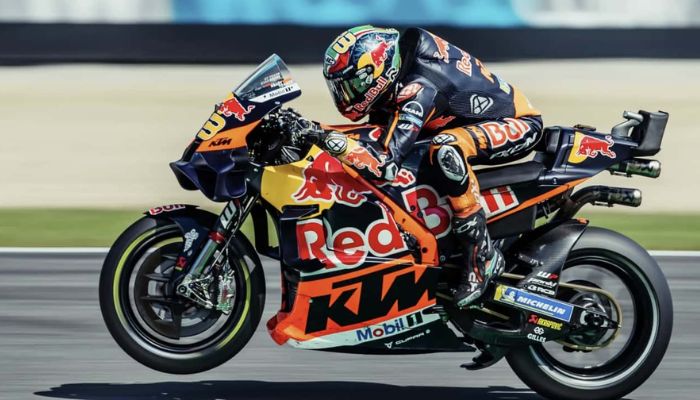
Since 2012, MotoGP has used the 1000cc formula. Before that, engines were 800cc. The change made bikes faster and louder. Fans loved it. Today, MotoGP bike specifications follow strict rules. The FIM (governing body) wants fair racing. But within those rules, engineers work magic.
The main specs are:
- Engine size: 1000cc (exactly 81mm bore x 48.5mm stroke max)
- Minimum weight: 157 kg (346 lbs) including rider
- Fuel tank: 22 liters (5.8 gallons)
- Maximum RPM: Up to 18,000 (but teams shift lower for reliability)
These numbers sound simple. But each one hides incredible tech.
You may also read :- MotoGP Bike Top Speed: How They Hit 363.6 km/h (226 mph)
MotoGP 1000cc Engine Specs: Power, Torque, and RPM Secrets
Let’s talk about the heart of the bike. MotoGP 1000cc engine specs are mind-blowing. These engines produce over 280 horsepower. To put that in perspective, a family car needs 2,000cc to make 150 hp. But here is the shocker: that engine weighs only about 45 kg (99 lbs). That’s like a small suitcase.
How do they do it?
- Pneumatic valves (air, not metal springs, close the valves)
- Titanium connecting rods (super light and strong)
- Seamless gearbox (changes gears without losing power flow)
One engine builder told me: “We spend $2 million just on valve spring research.” That shows how deep the details go.
Horsepower Numbers Across Different MotoGP Bikes
Not all MotoGP bike horsepower and speed numbers are the same. Each manufacturer takes a different path.
- Ducati (V4 engine): ~290+ hp (best top speed)
- Aprilia (V4): ~285 hp
- Honda (V4): ~280 hp
- Yamaha (Inline-four): ~275 hp (better cornering)
- KTM (V4): ~285 hp
Ducati wins the power crown. Their bike hit 366 km/h (227.4 mph) in 2023 at Mugello. That’s faster than some jets take off. But power is useless without control. That’s where weight comes in.
MotoGP Bike Weight and Power: The Perfect Ratio
Here is a key MotoGP bike weight and power fact. A MotoGP bike weighs 157 kg with the rider. That rider might be 65 kg. So the bike alone is about 92 kg (203 lbs). Do the math: 290 hp ÷ 157 kg = 1.85 hp per kg. A Bugatti Chiron? About 0.5 hp per kg. So a MotoGP bike is almost four times more powerful per pound. Crazy, right?
Why does weight matter so much?
- Lighter bikes stop faster (carbon brakes help too)
- They change direction quicker (chicane sections)
- They accelerate harder (Newton’s law: Force = mass x acceleration)
One rule trick: teams must add ballast if underweight. They put lead weights low in the frame to keep the center of gravity down.
MotoGP Bike Engine Details: From Air Intake to Exhaust
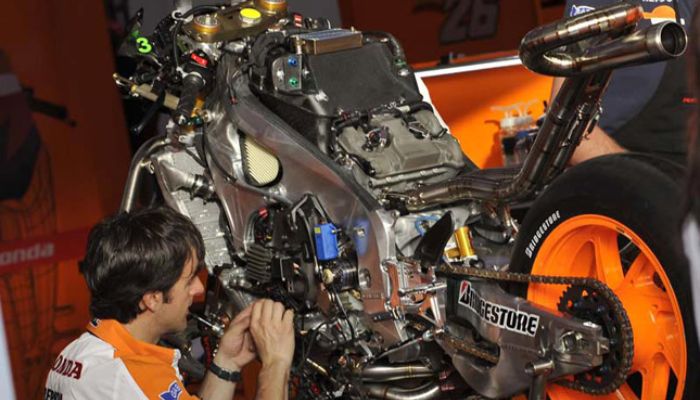
Let’s dig into MotoGP bike engine details. These are not car engines turned sideways. They are born for bikes.
Key engine parts:
- Airbox: Holds pressurized air. At 200 mph, air rams in like a turbo.
- Fuel injectors: 8 tiny nozzles per cylinder (sprays fuel 50 times per second)
- Exhaust: Made of Inconel (a space shuttle metal). It glows red-hot.
The firing order matters too. A “Big Bang” engine fires two cylinders close together. This helps rear tire grip. A “Screamer” fires evenly. It makes more top power but slides more.
Expert quote:
“The engine is a bomb. But we control the explosion down to one millisecond. That’s the art.” – Former Ducati engine engineer (anonymous due to contracts).
MotoGP Bike Performance Data: Lap Times vs. Raw Numbers
MotoGP bike performance data is not just about speed. It’s about lap time. A faster top speed means nothing if you cannot turn.
Let’s compare the 2024 specs to a road superbike (like a Ducati Panigale V4R).
| Metric | MotoGP Bike | Road Superbike |
|---|---|---|
| Horsepower | 290 hp | 240 hp |
| Weight | 157 kg | 200 kg |
| Brakes | Carbon discs (340mm) | Steel discs (330mm) |
| Lap time (Barcelona) | 1:38 | 1:46 |
That 8-second gap is massive in racing. It comes from electronics, aerodynamics, and tires as much as engine power.
Real-world example: At the 2023 Thai GP, Francesco Bagnaia used 6% less throttle than his teammate but went faster. Why? Better corner exit. Power is nothing without timing.
Chassis and Aerodynamics: How MotoGP Bike Specifications Shape Speed
Engines get the headlines. But the chassis decides winners. Modern MotoGP bike specifications include front and rear wings. Yes, wings on a motorcycle. Why wings? At 200 mph, wind wants to lift the front wheel. Wings push down. Simple physics.
MotoGP Bike Specifications for Chassis Materials
Most MotoGP frames use aluminum twin-spar design. It looks like two beams holding the steering head. But some test carbon fiber.
- Ducati: Carbon fiber chassis (light but stiff)
- Honda: Aluminum (more flex for corner feel)
- Yamaha: Aluminum with special flex zones
Flex is not a bad word. A frame that twists a little helps the rider feel grip. Too stiff, and the bike skips. Too soft, and steering gets vague. The swingarm (holds the rear wheel) is usually aluminum or carbon. It must resist twisting under 290 hp.
MotoGP Bike Horsepower and Speed: Electronics Tame the Beast
You cannot just twist the throttle on a MotoGP bike. You would flip over backward. The electronics suite is smarter than your car’s.
Key electronic aids:
- Traction control: Measures wheel spin 400 times per second
- Wheelie control: Cuts power if front lifts too high
- Engine braking: Opens throttle slightly when you brake
- Launch control: Holds RPM for perfect starts
These systems use a 6-axis IMU (gyroscope). It knows pitch, roll, yaw, and acceleration. One rider said: “It feels like the bike reads my mind.”
And here is the secret: All MotoGP bikes have the same spec electronics hardware (from Magneti Marelli). Only the software is different. That’s where engineers earn their pay.
Tires, Brakes, and Fuel: Supporting Cast in MotoGP Bike Specifications
Power is nothing without stopping. And stopping is nothing without grip. Let’s explore the hidden heroes.
MotoGP Bike Performance Data for Braking
MotoGP bikes brake later than any race car. At 220 mph, they pull 2.5 G of deceleration. That means your face pulls forward with 2.5 times your weight.
Brake specs:
- Front discs: 340mm carbon (no holes, they are smooth)
- Calipers: 4-piston (each piston pushes 100 kg of force)
- Pads: Made of carbon (they work hot at 800°C)
Once, a rider touched his brake disc after a race. His glove melted. Do not try that.
MotoGP 1000cc Engine Specs for Fuel Efficiency
This shocks people. A MotoGP engine is only 28% fuel efficient. That means 72% of the fuel becomes heat. The exhaust glows, the radiators blow hot air, and the rider bakes. But the rules say only 22 liters of fuel. So engineers chase efficiency.
Fuel facts:
- Uses 102-octane racing gasoline (similar to premium pump gas, but cleaner)
- Injectors spray at 100 bar (pressure washer levels)
- Fuel consumption: 1.5 liters per lap (average track)
At the end of a 25-lap race, the tank is nearly empty. Riders pray they have enough.
Comparing MotoGP to Other Race Bikes (WSBK and Moto2)
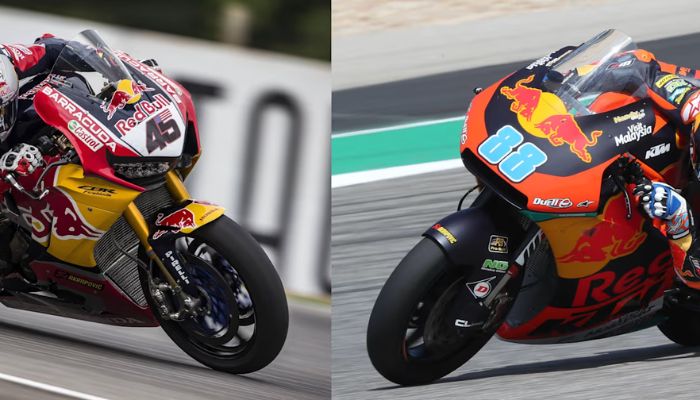
How do MotoGP bike specifications compare to World Superbike (WSBK)? WSBK bikes look like street bikes. MotoGP bikes look like aliens.
| Feature | MotoGP | World Superbike |
|---|---|---|
| Engine | Prototype 1000cc | Street-based 1000cc |
| Weight | 157 kg | 168 kg |
| Power | 290 hp | 230 hp |
| Tires | Slicks (custom made) | Slicks (production) |
| Cost per bike | $2 million | $400,000 |
Moto2 (the support class) uses 765cc Triumph engines with 140 hp. Moto3 uses 250cc singles. So MotoGP is the king of the mountain.
Opinion: If you ask me, the MotoGP bikes are too fast for most tracks. They brake so late that passing is nearly impossible without contact. But that’s progress.
Future MotoGP Bike Specifications: 850cc and More
Change is coming. In 2027, MotoGP will switch to 850cc engines. The goal is safety and cost.
New rules coming:
- Engine size: 850cc (down from 1000cc)
- Fuel: 100% sustainable (no fossil fuels)
- Aerodynamics: Heavily restricted (no huge wings)
Power will drop to about 230 hp. But lap times might stay similar because bikes will be lighter and more agile.
One engineer told me: “We are sad to lose the 1000cc scream. But 850cc will be fun in a different way.”
For now, enjoy the 1000cc monsters. They are the peak of motorcycle engineering.
Frequently Asked Questions About MotoGP Bike Specifications
Q1: What is the exact minimum weight of a MotoGP bike?
The rule says 157 kg (346 lbs) including the rider. If the bike alone is too light, teams add ballast. If the rider is heavy, the bike can be slightly lighter.
Q2: Do all MotoGP bikes have the same horsepower?
No. MotoGP bike horsepower and speed vary by brand. Ducati has around 290 hp. Yamaha has about 275 hp. But the Yamaha turns better, so lap times are close.
Q3: How much does a MotoGP engine cost to build?
Each rider uses 6-8 engines per season. So engine costs alone are $2-4 million per rider.
Q4: Why don’t MotoGP bikes use turbochargers?
Rules ban turbochargers and superchargers. Only naturally aspirated engines are allowed. This keeps costs down and racing close.
Q5: Can I buy a MotoGP bike for the street?
No. They are not street legal. No lights, no horn, no mirrors. But you can buy a Ducati Superleggera V4 ($100,000) which comes close. It has 234 hp and a carbon frame.
Final Verdict: MotoGP Bike Specifications Are Pure Art
Now you know the truth. MotoGP bike specifications are not just numbers on a page. They are the result of millions of hours of work. From the MotoGP 1000cc engine specs to the carbon brakes, every part has a purpose. These bikes weigh less than two adult humans. They produce more power than a family SUV. And they do it for 45 minutes without breaking.
Next time you watch a race, remember: that bike has more tech than a spaceship from 1990. And the rider? Just a human trying to hold on. Ride safe, and keep dreaming of those 290 horses.
.webp)